Photographic processes and first results
The Niépce Heliograph, made in 1827, is the earliest photograph produced with the aid of the camera obscura known to survive today.
Motivated by the growing popular demand for affordable pictures, Niépce’s photographic experiments were conducted with the means of copying prints and recording scenes from real life in the camera. Over the next decade he tried an array of chemicals, materials, and techniques to advance the process he ultimately called héliographie, or ‘sun writing’.

The first color photograph was taken by the mathematical physicist, James Clerk Maxwell. The image shows a colored ribbon, and is considered the first durable color photograph. It was unveiled by Maxwell at a lecture in 1861.
The inventor of the SLR, Thomas Sutton, was the man who pressed the shutter button, but Maxwell is credited with the scientific process that made it possible.
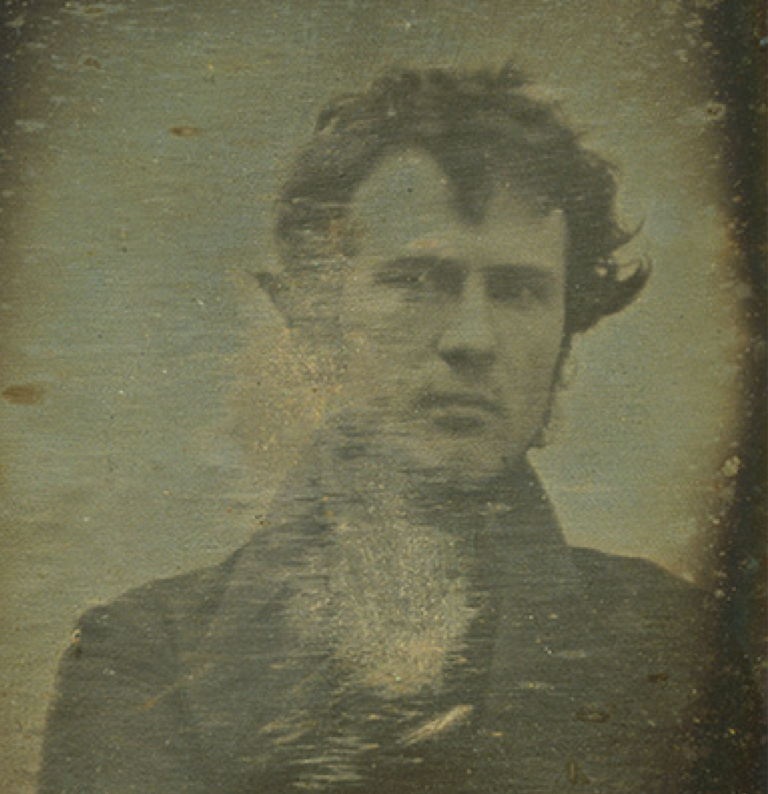
An early photograph, made in 1839 by Robert Cornelius depicting himself, is widely referred to as the first selfie in world history —it seems that it is at least the first self-portrait made by daguerreotype-processing.
The first photograph of a human appeared above in a snapshot captured by Louis Daguerre. The exposure lasted around seven minutes and was aimed at capturing the Boulevard du Temple, a thoroughfare in Paris, France.
Due to the long exposure time, many individuals who walked the street were not in place long enough to make an impression. However, in the lower left of the photograph, we can see a man standing and getting his shoes polished. Further analysis of the picture later found a few other figures – can you find them?
The first digital photo was taken in 1957; that is almost 20 years before Kodak’s engineer invented the first digital camera. The photo is a digital scan of a shot initially taken on film. The picture depicts Russell Kirsch’s son and has a resolution of 176 x 176 – a square photograph worthy of any Instagram profile.